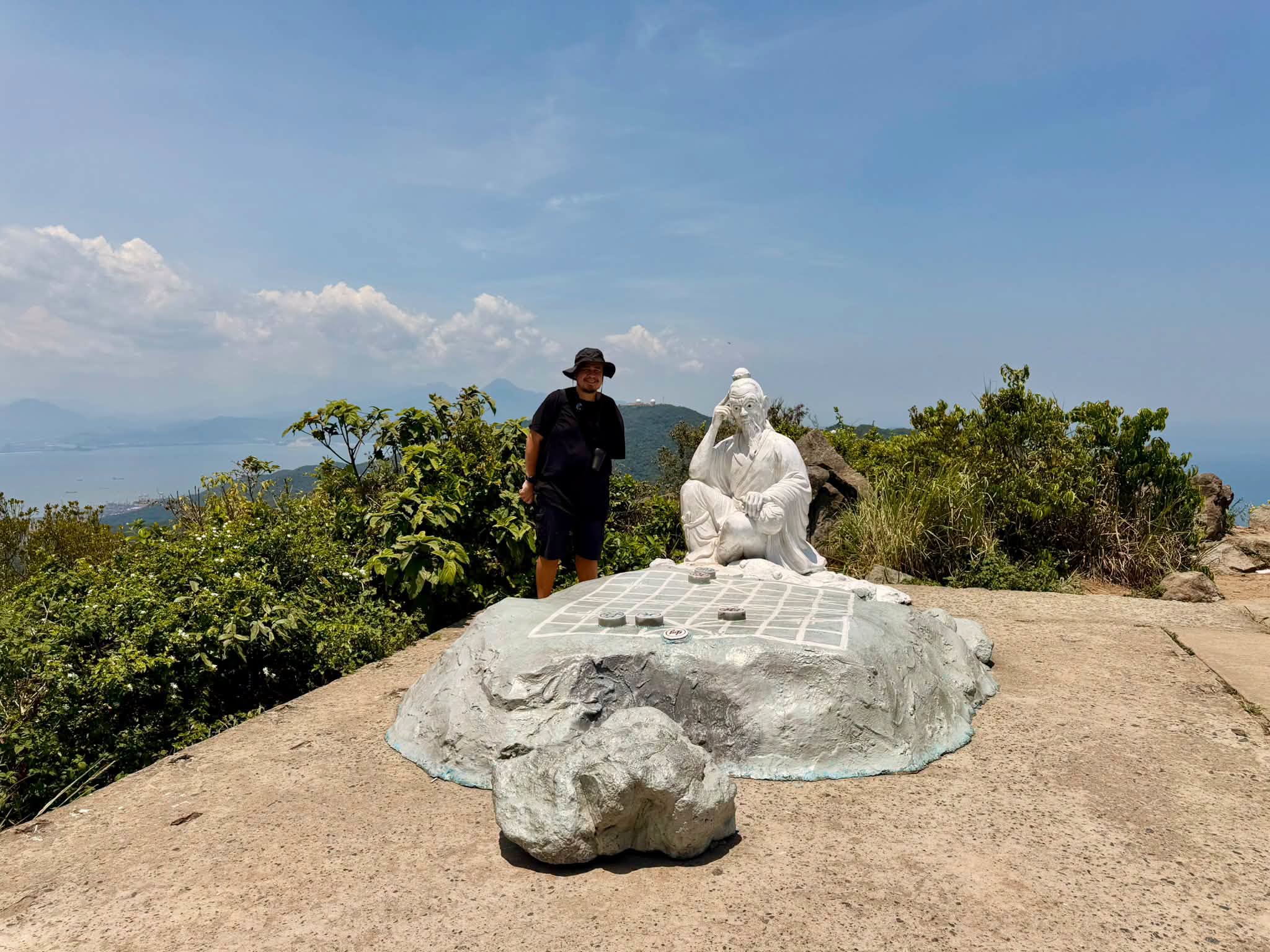
Ban Co Peak is one of those Da Nang places that looks easy on Instagram. A stone chessboard, a statue sitting above the city, clouds, ocean, green forest. Very peaceful.
Then you actually go there and discover that mountains have apparently not agreed to become Instagram-friendly.
Ban Co Peak sits on Son Tra Peninsula at roughly 700 metres above sea level. The road winds through thick forest before reaching the famous viewpoint, where you can look across Da Nang, the Han River, the coastline and, on a clear day, much farther toward the surrounding mountains and sea.
If you are planning to climb or visit Ban Co Peak, here is what you actually need to know.
1. First, understand what climbing Ban Co Peak really means
There is a small problem with the word climbing.
For most visitors, Ban Co Peak is not a serious mountain trek. You normally travel up Son Tra by road and then walk the final section to the viewpoint. The road itself is the difficult part, with steep gradients, sharp bends and sections where the scenery becomes so good that stopping for a photo feels like a reasonable excuse to forget you are sitting on a mountain road.
The final approach to the chessboard involves stairs and a short uphill walk. You do not need hiking equipment or the fitness of someone who runs up mountains before breakfast.
Comfortable shoes are enough.
If you want a real trekking experience, there are forest routes around Son Tra, but these are a different activity. I would not wander into an unofficial forest trail because Google Maps confidently showing a line through the jungle is not the same thing as Da Nang authorities saying humans should walk there.
2. Choose your way up carefully
The main visitor route is from Yet Kieu toward Ban Co Peak and then onward toward Bai Bac. Under the current Son Tra management rules, the mountain routes have controlled access and vehicle restrictions. Automatic scooters are restricted on the designated route, while cars and certain motorcycles can use permitted sections.
This matters because plenty of old travel articles still tell visitors to simply rent a scooter and ride everywhere.
That advice is becoming increasingly unreliable.
My practical preference is simple: if you are not an experienced rider on steep mountain roads, take a car with a local driver. You lose a little of the adventure and gain considerably more peace of mind.
If you do ride a permitted motorcycle, check the brakes, tires and fuel before going up. The descent is where people discover that gravity has excellent brakes and you do not.
Also remember that the road beyond Ban Co Peak toward Bai Bac operates as a one-way section. Do not casually assume you can drive up, turn around and return exactly the same way.
3. Go early, but do not blindly chase the famous sunrise
Sunrise at Ban Co Peak is beautiful.
There is also a tiny problem with the sunrise obsession: the current managed visiting hours begin at 7:30am. From March through September, the official visiting window is 7:30am to 6:30pm. From October through February, it becomes 7:30am to 5:30pm. Access can also be suspended during dangerous weather.
So those old blog posts telling you to arrive at 5am belong in the great internet museum of outdated travel advice.
For a normal visit, I prefer going in the morning after opening or during the earlier part of the afternoon.
Morning usually gives you cooler temperatures and softer light. The afternoon can give you beautiful views toward the city, but clouds and haze can completely change the experience.
And do not underestimate Son Tra weather. You can leave sunny Da Nang and find yourself surrounded by mist a short time later.
That is not necessarily a disaster. Sometimes the mountain disappears into clouds and looks fantastic.
Sometimes you see absolutely nothing.
Nature, unlike your hotel, does not accept complaints at reception.
4. The best part is actually the road, not the chessboard
This is something I think many first-time visitors miss.
Ban Co Peak itself is interesting, but it is small.
You arrive at the famous stone chessboard and the statue associated with the local legend of immortals playing chess on the mountain. The name Ban Co means chessboard, and the story says that celestial players came down to the mountain to play. One eventually returned to heaven while the other remained behind.
The viewpoint is the real reward.
From up there, Da Nang looks completely different from street level. The city becomes a geometric patchwork of buildings, bridges and roads, while the coastline stretches into the distance.
On a clear day, you can see major parts of Da Nang, the sea and surrounding mountain landscapes. The combination of jungle immediately behind you and the city far below is what makes Son Tra special.
And here is a fun fact that is more interesting than another photograph of the chessboard: Son Tra is home to the endangered red-shanked douc langur, one of Vietnam’s most spectacular primates.
If you see one, do not feed it, chase it or try to become its new best friend. The monkeys and langurs live here. You are the visitor.
Another strange little detail: Son Tra also has an ancient heritage banyan tree, estimated at around 800 years old, with huge aerial roots. The designated route to the tree is for walking only.
5. My honest review: is Ban Co Peak actually worth it?
Yes, but with one important qualification.
I would not travel across Vietnam just to see the chessboard.
The chessboard is not that impressive.
The mountain, the road, the forest and the view are the reason to go.
For someone living in Da Nang, Ban Co Peak is much more valuable. It is close enough to become a half-day escape from the city rather than a major tourist expedition.
My personal advice would be to combine it with other parts of Son Tra instead of treating Ban Co Peak as a standalone attraction. Take your time going up, stop at viewpoints, visit Linh Ung if it fits your route, enjoy the forest and then continue according to the current permitted roads.
Do not rush to the top just to take one photograph and leave.
And do not believe every online guide that tells you the mountain is completely wild and untouched. It is a managed visitor area with controlled routes, opening hours and vehicle restrictions. The rules have changed significantly since the mountain routes were affected by landslides and later reopened under a management plan.
The simple version
Wear proper shoes.
Bring water.
Start early.
Check the weather.
Do not use an automatic scooter where it is restricted.
Drive slowly if you are riding a permitted motorcycle.
Expect steep roads and sharp corners.
Leave enough time before the mountain closes.
Do not feed wildlife.
And when you finally reach the chessboard, take the photograph.
Then stop taking photographs for five minutes.
Actually look at Da Nang.
That is the part you came all the way up the mountain for.